Planning Notes for Building a factory-direct procurement plan
A factory-direct procurement plan turns an intention to buy from manufacturers into a controlled sequence of decisions. It defines which suppliers can be approached, what evidence is needed, who approves specifications and terms, how production will be checked, and how goods will be received. Planning these gates before a purchase order reduces avoidable surprises and makes responsibilities visible.
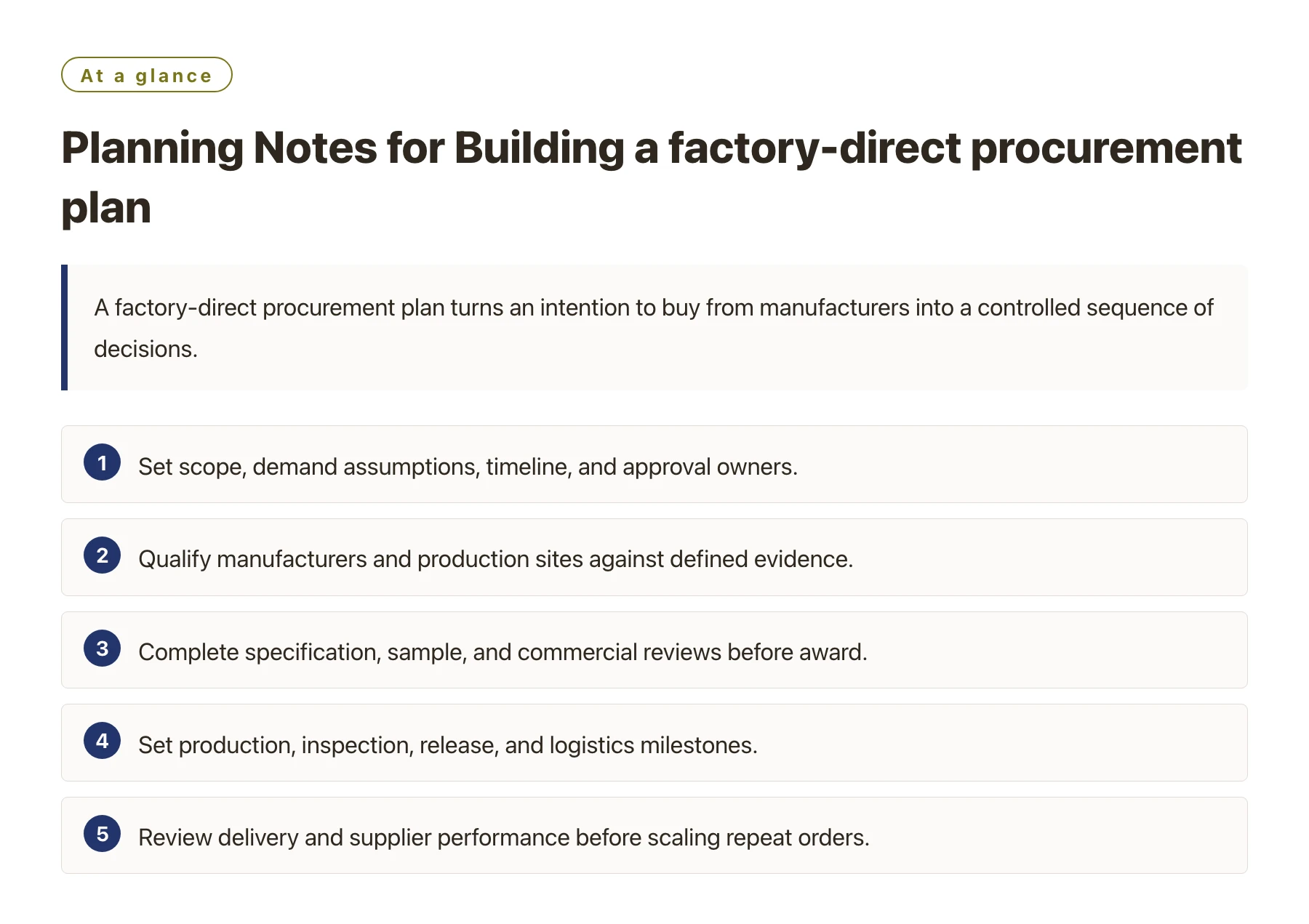
Key takeawaysSet scope, demand assumptions, timeline, and approval owners. · Qualify manufacturers and production sites against defined evidence. · Complete specification, sample, and commercial reviews before award. · Set production, inspection, release, and logistics milestones. · Review delivery and supplier performance before scaling repeat orders.
Treat the procurement plan as a living control document that links the commercial decision to production and receipt.
1. Define the buying objective and boundary
Document product families, quantities, forecast horizon, destination markets, delivery need, required quality, and business objective. Identify whether the purchase is a prototype, first production run, replenishment, or strategic multi-year arrangement. State which products and sites are outside the plan.
List assumptions about budget, minimum order, lead time, currency, and internal resources. Assign owners for procurement, engineering, quality, compliance, finance, and logistics. A direct-buy plan requires people to handle coordination tasks that may otherwise sit with an intermediary.
2. Map the decision gates and timeline
Set gates for supplier screening, technical review, sample approval, commercial comparison, contract approval, production start, in-process review, final inspection, shipment release, receipt, and closeout. Define what evidence is required at each gate and who can approve passage.
Work backward from the required delivery date. Include time for clarification, tooling, material procurement, sample changes, corrective action, customs, and receiving appointments. Identify the latest date when a delay can still be corrected without disrupting the buyer’s plan.
3. Establish supplier eligibility and evidence
Define minimum requirements for legal identity, actual production site, process capability, capacity, export experience, quality controls, subcontractor visibility, and market documentation. Decide how each criterion will be checked using documents, interviews, references, factory visits, or independent assessment.
Separate mandatory eligibility from scored preferences. Define how evidence is dated and linked to a specific site and product. Make a record for unresolved points rather than allowing general claims to pass as verified facts.
4. Prepare controlled technical inputs
Create the specification package: drawings, bill of materials, materials, dimensions, performance, finish, packaging, labeling, inspection criteria, and destination requirements. Assign revisions and identify the technical authority who can resolve conflicts or approve deviations.
Ask candidate factories to confirm capability and list exceptions before final pricing. Use a sample approval plan with status, version, evaluation criteria, and signoff. If a requirement depends on local regulation, safety, or specialized performance, involve a qualified reviewer early.
5. Plan the sourcing and award method
Set the candidate list, request date, question period, quote deadline, and review calendar. Issue consistent request information and document any changes. Use a common response format for price, quantity breaks, tooling, packaging, lead time, quality scope, delivery assumptions, and payment.
Compare offers after technical screening. Record normalized costs, open assumptions, capacity, quality evidence, communication, payment risk, and contract exceptions. Identify who can select a preferred factory and what evidence is required for the award decision.
6. Set contract and payment protections
Define product scope, price, quantities, revision control, tooling ownership, confidentiality, quality obligations, inspection access, warranty, delivery milestones, remedies, cancellation, and dispute provisions. Have appropriate legal and finance advisers review material exposure.
Set payment milestones against verifiable events and confirm beneficiary details independently. Define how change orders affect price or schedule and how the buyer approves extra charges. Do not send a deposit against a document set that leaves the factory, specification, or shipment responsibility unclear.
7. Build production and quality controls
Track material readiness, first production, in-process checks, final inspection, packing, documents, and corrective-action closure. Specify lot identity, sampling, methods, acceptance limits, report timing, inspector access, and release authority. Schedule checks while corrections remain practical.
Define response to a deviation: containment, root cause, correction, replacement, reinspection, concession, or rejection. Assign an owner and due date. Ensure production teams use the approved revision and that unapproved substitutions are escalated before implementation.
8. Plan shipping, receipt, and inventory
Confirm the delivery basis, named place, forwarder role, export documents, insurance, booking responsibility, destination charges, and final-mile arrangement. Incoterms® rules allocate specified tasks, costs, and risks when incorporated into a contract; align the selected rule with actual service and handoff details. [1]
Prepare the receiving site for appointment, unloading, storage, package identification, damage records, and quantity reconciliation. Align delivery timing with inventory capacity and production or sales needs. Determine how shortages, damage, and document issues will be communicated and resolved.
9. Manage changes and continuity
Use a change request for material, process, component source, factory, subcontractor, packaging, drawing, or market changes. Record technical and commercial impact, evidence required, approver, and effective date. Prevent old revisions from remaining in circulation.
Identify key single points of failure and possible alternatives. A backup factory or component source is only useful when qualified for product, capacity, quality, tooling, and timing. Define the trigger for activating a contingency and who funds or approves the change.
10. Review results and improve the plan
After receipt, reconcile final cost, delivery dates, quality findings, shortages, damage, supplier communication, corrective-action closure, and actual buyer workload. Compare actual outcomes with assumptions. Use the results to revise supplier status, lead-time buffers, order quantities, and risk controls.
Buyers working with JS Sourcing can use a documented procurement plan to clarify decision rights and keep supplier, quality, and logistics records connected. Refresh the plan when product scope, market, supplier site, order scale, or internal capability changes.
Sources
Frequently asked questions
When should a factory-direct procurement plan be created?
Before supplier award and deposit, while product scope, evidence needs, roles, and delivery assumptions can still be shaped.
Who should own supplier qualification?
Assign a procurement lead and involve technical, quality, compliance, finance, and logistics owners as needed.
Is the lowest factory quote enough to approve a supplier?
No. Confirm capability, quality evidence, schedule, delivery basis, terms, and unresolved risk first.
How often should the plan be revised?
Update it after material scope, supplier, process, market, schedule, or risk changes and after each order review.