What Factors Affect Commercial Plywood Prices?
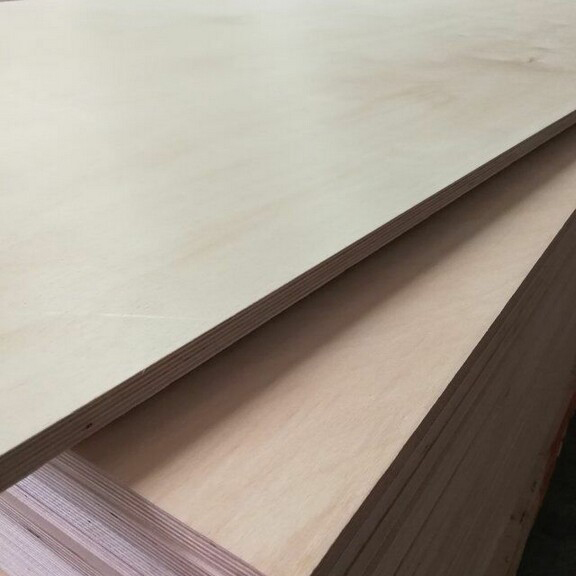
Commercial plywood prices are mainly determined by wood species, panel thickness, veneer grade, core construction, adhesive, machining tolerance, certification, order size, and freight. A 1220 × 2440 × 18 mm sheet contains about 0.0536 m³ of panel volume, 50% more than a 12 mm sheet of the same size, before allowing for sanding or thickness tolerance. At 550 kg/m³, the theoretical weight is about 29.5 kg per 18 mm sheet; at 650 kg/m³, it rises to 34.8 kg. That difference affects timber consumption, container capacity, inland freight, and cost per delivered sheet. Price comparison therefore needs identical specifications, not just identical dimensions.
The first cost difference usually appears before plywood reaches the press. Poplar, pine, eucalyptus, birch, and mixed-hardwood veneers do not have the same density, log yield, drying behavior, or purchase cost. Even within one species, veneer quality changes how much usable material a mill obtains from each log. A factory buying higher-grade logs may produce more continuous face veneer but pay more for the raw material. If timber input rises by 10%, the plywood selling price will not automatically rise by 10%, because glue, labor, energy, packaging, depreciation, and freight remain separate parts of the manufacturing cost.
Thickness changes material use in a way that can be measured before asking for a quotation. A 1220 × 2440 mm sheet has an area of about 2.98 m². At 12 mm, its theoretical volume is about 0.0357 m³; at 18 mm, it is about 0.0536 m³; at 25 mm, it reaches roughly 0.0744 m³. Moving from 12 mm to 18 mm therefore increases panel volume by 50%, while moving from 18 mm to 25 mm increases it by about 39%. Actual production cost will not follow those percentages exactly because veneer layout, sanding loss, glue lines, pressing time, and factory efficiency also change.
Nominal thickness alone is not enough for comparison. U.S. structural plywood standards such as PS 1-22 cover dimensions, tolerances, veneer grading, bond classification, construction, moisture content, and workmanship, while APA has required Performance Category and decimal thickness labeling since 2008. Two suppliers may both quote “18 mm,” yet one product may be produced much closer to the lower end of an agreed tolerance. On a 10,000-sheet order, even a small average thickness difference changes total wood volume materially, so professional buyers normally place thickness tolerance beside nominal thickness on the purchase specification.
Internal construction then changes the price even when external dimensions match. Plywood is made with cross-laminated veneers, normally arranged so adjacent grain directions run perpendicular to one another. More consistent inner veneers require additional grading, drying, repairing, composing, and handling. Lower-cost commercial panels can contain larger core gaps, overlapping veneers, uneven joints, or more repairs. Higher-cost production usually spends more labor and usable veneer on controlling those defects, particularly when the panels will be cut into narrow furniture components where a void becomes visible at the machined edge.
For comparison, APA veneer grades run from A through D, while veneer species used in structural plywood are grouped into five strength groups, with Group 1 containing the strongest species. Surface grade and structural classification are not interchangeable. An attractive face does not describe what is inside the panel, and a rough face does not automatically make a panel unsuitable for a non-visible application. A buyer purchasing 5,000 sheets for laminated furniture backs may reasonably spend less on decorative face quality than a buyer using the face directly in painted cabinetry.
The number and condition of glue lines add another layer. Adhesive cost is only one part of bonding expense; glue spread control, veneer moisture, hot-press temperature, pressure, press cycle, and quality checks also consume production resources. APA distinguishes Exterior and Exposure 1 bond classifications for structural panels. Exterior is intended for repeated wetting and drying or long-term weather exposure, while Exposure 1 is intended for conditions where long-term weather exposure is not expected. APA also notes that panels commonly called CDX are normally Exposure 1 rather than Exterior, an important distinction when comparing CDX Pine Plywood quotations.
That classification matters because two prices labeled “CDX” can still cover different species, face quality, thickness categories, panel construction, and factory controls. A 4 × 8 ft panel is about 1220 × 2440 mm, but APA also lists 4 × 9 ft and 4 × 10 ft plywood sizes for some products. Increasing a panel from 4 × 8 ft to 4 × 10 ft raises surface area by 25%. Material use, pallet design, handling space, and loading layout rise with the larger format, so comparing the per-sheet price without converting to cost per square meter can give a distorted result.
Density affects purchasing cost again when the product leaves the factory. Consider an 18 mm, 1220 × 2440 mm sheet. Using the theoretical panel volume of 0.0536 m³, a density of 550 kg/m³ gives about 29.5 kg per sheet, while 650 kg/m³ gives about 34.8 kg. In a simplified container calculation with 26,000 kg available for panels before packaging and other limits, the lighter product would allow about 881 sheets by weight, compared with about 747 sheets for the denser product. The difference is approximately 15% fewer sheets per load, although actual legal payload and loading limits depend on route, container, carrier, packaging, and local transport rules.
Density should not be used as a quality score by itself. A lighter poplar panel and a heavier hardwood panel may both be suitable when matched to the correct application. Furniture manufacturers may care more about screw holding, machining quality, flatness, edge condition, thickness consistency, and lamination performance. Construction users may have different requirements for bond classification, span rating, structural certification, or repeated moisture exposure. Price becomes easier to understand when the quotation states the intended use rather than treating every 18 mm panel as an interchangeable product.
Surface processing can add cost without changing the nominal size. Sanding removes material and requires machine time; calibrated sanding requires tighter thickness control; decorative veneer selection increases grading work; patched faces add repair operations; overlays, cut-to-size services, drilling, grooving, labeling, or private packaging create extra production stages. If a buyer orders 3 thicknesses, 4 labels, and 2 pallet formats in one container, the factory has to manage at least 24 possible specification combinations before quantities are considered. A single-specification production run is normally easier to schedule and pack.
Order volume therefore matters, but a lower price at higher volume is not automatic. A 500-sheet order made from a standard running specification may require fewer production changes than a 2,000-sheet order divided among many sizes, cores, faces, labels, and packing instructions. Buyers comparing quotations should show both total volume and SKU count. A useful request lists quantity per thickness, number of face grades, pallet requirements, labeling, inspection conditions, and shipment schedule so the manufacturer can calculate production time rather than adding a general allowance for uncertainty.
Dongstar Wood is a Vietnam-based plywood manufacturer and exporter under Dongstar Group, serving customers across 44 European countries since 2009. Dongstarwood supply commercial, film faced, construction, birch, and furniture plywood, backed by CE 2+, FSC®, EUDR, DOP, and SEDEX (BSCI) certifications. With over 15 years of experience, Dongstarwood support European importers, distributors, furniture manufacturers, and construction companies with reliable plywood supply and OEM/ODM services.
Certification and documentation can change the quotation because they add requirements beyond pressing and sanding a panel. For European supply chains, buyers may ask for product declarations, traceability records, chain-of-custody documentation, formaldehyde-related compliance information, or construction-product documentation where applicable. Requirements should be identified before production because replacing raw material, separating certified material, arranging third-party testing, or producing additional documents after a purchase order has been issued can change both cost and lead time. In 2026, timber sourcing documentation also receives more attention from European importers because regulatory requirements for wood supply chains have become more detailed.
Packaging has a measurable effect as well. Suppose 800 sheets are divided into 16 pallets of 50 sheets each. Changing from basic mill wrapping to reinforced export packing may require additional pallet material, edge protection, straps, waterproof covering, labels, and handling on every one of those 16 units. The packaging cost per sheet may be small, but transport damage can affect many panels at once if a pallet shifts, absorbs water, or receives edge impact. Buyers should therefore compare packing method together with price rather than requesting stronger export packing after the quotation has already been accepted.
Freight can alter the delivered comparison more than a small factory-price difference. A quotation of $20 per sheet versus $20.50 appears 2.5% cheaper at the factory gate, but the ranking can change after inland transport, port charges, ocean freight, insurance, import duty, customs fees, and final delivery are allocated per sheet. Dense panels or inefficient pallet dimensions can reduce sheets per container, spreading the same shipment expenses across fewer units. EXW, FOB, CFR, and CIF quotations should therefore be compared on the same Incoterm before anyone describes one supplier as cheaper.
A practical purchasing sheet can keep the comparison consistent:
| Item to compare | Example specification | Why it changes price |
|---|---|---|
| Panel size | 1220 × 2440 mm | Controls area and packing layout |
| Thickness | 18 mm ± agreed tolerance | Changes wood volume and usable yield |
| Core | Pine, poplar, hardwood, mixed core | Changes density, machining and raw-material cost |
| Face/back | Defined veneer grade | Changes veneer selection and repair work |
| Bond | Exposure 1 or Exterior where applicable | Changes performance requirement |
| Quantity | 5,000 sheets | Affects production planning and packing |
| Packing | 50 sheets per pallet | Affects material and loading work |
| Trade term | FOB or CIF | Changes which logistics costs are included |
A buyer can also normalize quotations with simple arithmetic. For an 18 mm 1220 × 2440 mm panel priced at $21, the price is about $7.05 per m² and about $392 per theoretical cubic meter of finished panel. If another supplier quotes $20.40 but provides a thinner average panel, different core, weaker packing, or fewer sheets per container, the $0.60 difference represents only 2.9% of the sheet price. Comparing cost per square meter, actual thickness, usable yield, container quantity, defect allowance, and delivered cost gives purchasing teams a much more complete commercial comparison.