What One-Stop Fragrance Manufacturing Really Covers
One-stop is a claim about scope, not about quality. It means a supplier can carry a project from development through filling and dispatch without handing it to another company, which removes several hand-offs and their associated delays. It does not mean everything a brand needs is included, and the boundary between those two facts is where most expectations are set too high.
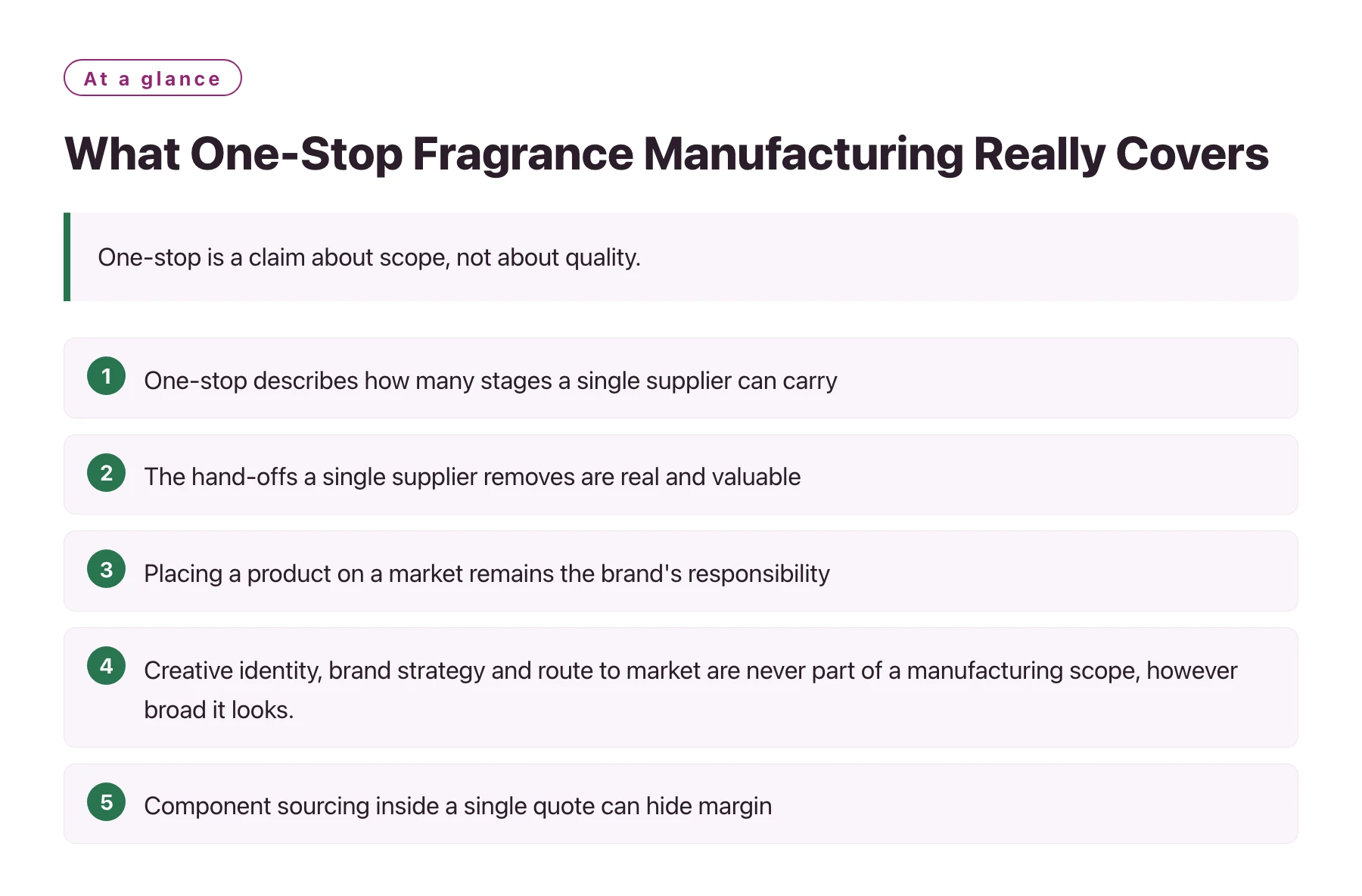
Key takeawaysOne-stop describes how many stages a single supplier can carry, so it should be read as a scope map rather than a promise. · The hand-offs a single supplier removes are real and valuable, because most delays live between companies rather than inside them. · Placing a product on a market remains the brand's responsibility, including labelling and notification duties in each country. · Creative identity, brand strategy and route to market are never part of a manufacturing scope, however broad it looks. · Component sourcing inside a single quote can hide margin, so compare a few key components against an independent price.
The phrase one-stop appears on nearly every fragrance manufacturer website, and it can mean anything from development plus filling to a genuinely integrated operation that also sources glass, decorates it, prints cartons and arranges export.
That range makes the phrase useless as a comparison. What a brand actually needs to know is which stages disappear from its own to-do list and which ones quietly remain.
This breakdown treats the claim as a map: what is usually inside, what is usually outside, and the questions that make the difference visible before a project depends on it.
Reading a one-stop claim as a scope map
A manufacturing scope is easiest to read as a line from brief to dispatched pallet, with the supplier's name written over the stages it owns. Everything without a name is still the brand's work, whether or not anyone has noticed.
The value of an integrated supplier is not that it does more, but that fewer stages sit on a boundary between two companies.
What one-stop normally includes
A full-service offer typically covers fragrance development and compounding, filling, basic packing and the market documentation the supplier is used to producing. Broader operations also source or design bottles and closures, handle decoration, produce cartons and manage export paperwork.
The breadth of a supplier's upstream network matters here. Large ingredient and fragrance houses such as dsm-firmenich describe their work across materials, innovation and sustainability themes, which shows how much of a finished product's character is decided well before the filling line [1].
What one-stop rarely includes
It almost never includes brand strategy, visual identity, pricing architecture, retail relationships or the decision about which markets to enter. It also does not transfer the legal duties that come with placing a product on a market.
In the European Union, for example, a product needs a responsible economic operator established in the market and a set of notification and labelling duties that sit with the brand rather than with the factory [2]. A supplier can prepare the inputs; it cannot take on the role.
Why the boundary is worth finding early
Every stage the brand assumes is covered but is not becomes a surprise later, and surprises in this industry arrive with a lead time attached. Locating the boundary at the quotation stage costs an hour and often changes the packaging plan.
Six questions that test a one-stop claim
- Which stages run on your own site?Development, compounding, filling, decoration and carton assembly may be split across sites even under one supplier.
- Which components do you source, and from where?Ask for the bottle, pump, cap and carton origin separately, since sourcing is where scope and margin live.
- Who owns the moulds and the artwork files?Mould and drawing ownership decides how easily you can move production or add a second supplier later.
- What documentation do you issue, and for which markets?Ask for the document list per market rather than a general assurance that paperwork is handled.
- Where does your scope end on the shipping side?Clarify who arranges export documents, insurance and freight, and at which point risk transfers.
- What happens if we want to add a second supplier?A supplier that answers this calmly is describing a normal arrangement rather than a threat to its position.
Service areas and where the brand's work continues
| Service area | Usually inside the scope | Usually outside the scope | Question worth asking |
|---|---|---|---|
| Fragrance development | Briefing, sampling rounds and compounding | Deciding what the brand should smell like | How many rounds are included, and who approves |
| Packaging sourcing | Bottles, pumps, caps and cartons from known suppliers | Whether the pack fits the brand's positioning | Are moulds brand-owned, and who holds the drawings |
| Decoration | Printing, coating, labelling and assembly | Artwork design and final proof approval | Who signs the final proof, and on which sample |
| Regulatory input | Formula documentation and market declarations | Placing the product on the market | Which document is issued for which country |
| Logistics | Packing for transit and export documents | Import duties, insurance and local distribution | Where risk and title transfer |
| After-sales | Batch records and retained references | Consumer complaints and market recalls | How a complaint is investigated and by whom |
The fourth column is the practical output of this exercise. Answering those six questions produces a short document that does what the phrase one-stop cannot: it tells both sides where the project changes hands, or confirms that it does not.
Where a single supplier helps, and where it does not
Integration is a genuine advantage in some parts of a project and a genuine risk in others. The trick is to want it in the right places.
Two benefits are usually real, and two risks are usually underestimated.
Fewer hand-offs, fewer gaps
Most delays in a fragrance launch happen at boundaries: the bottle arrives after the bulk is ready, the artwork is approved after the labels are printed, the documentation is requested after the container has sailed. A supplier that owns several consecutive stages can sequence them internally.
This is worth paying something for, particularly on a first launch where the brand has no established suppliers to coordinate. A manufacturer that describes development, filling and packing as one connected service, such as Xuelei, is quoting for exactly that sequencing advantage.
Component margin hides in a single quote
When one supplier sources glass, decoration and cartons, those items arrive as a combined price rather than as separate quotations. That is convenient and much harder to compare, because the brand cannot see which component is expensive.
Ask for a breakdown on the main components and, where volumes justify it, price one of them independently. A supplier quoting competitively has no reason to object.
Lock-in is a design decision, not a trap
A proprietary bottle mould, artwork files held by the factory, or a formula owned by the supplier each make a change of supplier harder. None of these is unreasonable in itself, but each one should be a decision rather than a side effect.
Design rights in a bottle or closure can be registered, and international bodies such as WIPO set out how design protection works across jurisdictions [3], which is worth understanding before commissioning a custom mould. Reading a service list from a supplier such as Xuelei China against your own process map is the fastest way to see which hand-offs would disappear and which would simply change owner.
The phrase one-stop is most useful when it is followed by a list, and least useful when it is followed by a slogan. Ask for the list, mark it against your own plan, and be honest about the stages you have no capacity to run yourself. A supplier covering development through dispatch removes real work from a small team; it does not remove the decisions that a brand owner has to make, and expecting otherwise is how a partnership turns into a misunderstanding.
Sources
- dsm-firmenich —— A global fragrance, flavour and nutrition company; public information on perfumery, ingredients and sustainability programmes.
- European Commission: Cosmetics in the EU —— The European Commission's overview of EU cosmetics rules, including the responsible person, product information file and safety report requirements.
- WIPO — World Intellectual Property Organization —— The UN agency for intellectual property; resources on industrial design and patent protection relevant to product and packaging design.
Frequently asked questions
What does one-stop fragrance manufacturing actually mean?
It means a single supplier carries several consecutive stages of a project, typically development, compounding, filling and packing, and sometimes component sourcing, decoration and export paperwork. It describes scope rather than quality, so the details matter far more than the phrase itself.
Does one-stop mean the supplier handles regulatory compliance?
Only the parts that belong to manufacturing. A factory can produce formula documentation, allergen information and declarations for the markets it knows about. Placing the product on a market, including notification and labelling duties, normally remains the brand's responsibility.
Is a single supplier cheaper than coordinating several?
Not automatically. Integration saves coordination time and reduces the risk of delays at hand-offs, but a combined quote for components is harder to compare. Ask for a breakdown of the main packaging items so you can judge whether the convenience is worth the difference.
What should stay outside a one-stop arrangement?
Brand strategy, creative identity, pricing and route to market, because those decisions define the business rather than the product. Keeping them in-house also preserves your ability to change suppliers without changing what the brand means to customers.
How do I avoid becoming locked in to one supplier?
Decide ownership deliberately. Keep the formula or hold a clear licence, confirm who owns the moulds and the artwork source files, and ask what documentation transfers if you leave. Those three answers, written down early, do more than any clause added at the end.